

How To Make Money On Runescape Non Member 2017
This article is virtually the dungeoneering skill. For information on preparation dungeoneering, see Dungeoneering training (F2P) (P2P).
 The official worlds for Dungeoneering are worlds 7 (F2P), 77 (P2P).


Dungeoneering level up music
RuneScape - Dungeons of Daemonheim
Dungeoneering is a back up skill that consists of exploring the dungeons of Daemonheim by solving puzzles, unlocking doors, fighting monsters and Bosses, and uses about RuneScape skills to solve puzzles to ultimately survive its depths. It is open to both gratis players and members. Dungeoneering takes place underneath an old castle named Daemonheim, which contains a dungeon of 60 floors with six dissimilar themes: Frozen, Abandoned I, Furnished, Abandoned 2, Occult, and Warped.
Unlike other skills that are trained alone, players tin can cooperate to train in groups of up to five people, receiving the most experience per dungeon, although soloing is possible and widespread. Most players choose to do the deeper floors with a group, rather than solo, considering the difference in feel awarded with larger party size is greater on those deeper floors. While completing these dungeons, players may also earn feel in other skills past accomplishing various skill-related tasks. The items and skilling materials involved are all unlike to their counterparts on the surface.
No items created or constitute within Daemonheim can exist removed from the dungeon; too, no items found or created on Gielinor can be taken into Daemonheim, with the exceptions of the Ring of kinship, any variant of the Dungeoneering skillcape, Orb of Oculus, certain auras like the Daemonheim aura and a scattering of diverse feel or corrective items.
Players tin train Dungeoneering past level 99 up to level 120, at which point players will have over 104 million feel. This level is called "true skill mastery". Although other skills offer equivalents, Dungeoneering was the first skill that offered actual obtainable levels by 99, and remained the only one for over five years until the release of Invention.
The current minimum requirement to be ranked (at approximately rank 806,930) on the hiscores for Dungeoneering is level 15. As of xvi August 2018, at that place are 119,157 electric current members that have achieved level 99 in Dungeoneering. There are 36,923 current members that have achieved level 120 in Dungeoneering.
Contents
- 1 Development history
- two Getting in that location
- 3 At Daemonheim
- 3.1 Preparing for a dungeon
- three.1.i Immune items
- iii.1.2 Starting a dungeon
- 3.1 Preparing for a dungeon
- 4 Making a party
- four.1 Floors
- 4.2 Complexity
- 4.iii Dungeon size
- 4.3.1 Suggested dungeon size
- 4.4 Prestige
- 4.five Party size difficulty
- 4.6 Guide mode
- 5 Gameplay
- 5.1 The Starting Room
- 5.2 Gatestones
- 5.3 Doors
- five.iv Other features of gameplay
- 5.4.i Political party mechanics
- 5.4.2 Items
- 5.4.3 Other
- v.5 Roles of the squad
- 5.six Abbreviations used inside Daemonheim
- five.7 Shared feel
- 5.eight Finding a team
- 6 Binding items
- 6.1 Suggested binds
- 7 Ending a dungeon
- 8 Related Activities
- eight.1 Daemonheim Chore Fix
- viii.2 Hard manner
- viii.3 Fremennik Sagas
- nine Skills
- x Combat
- xi Monsters
- 12 Bosses
- thirteen Nutrient
- 14 Spellbook
- xv Puzzles
- 16 Rewards
- xvi.1 Resources dungeons
- 17 Journal
- xviii Guides
- 19 Music
- 19.one Tips for unlocking music
- 20 Temporary boosts
- 21 Achievements
- 22 Skilling pet
- 23 Rollback and system updates
- 24 Gallery
- 25 Trivia
- 26 Videos
- 27 References
The skill is trained mainly within the dungeons of Daemonheim, although experience can as well be gained from Sinkholes and rewards such as XP lamps. This separates the skill'south grooming from the rest of Gielinor. However, some one-time experience rewards are bachelor from entering Resource Dungeons and completing quests which requite Dungeoneering experience.
Evolution history
On xix July 2010, the skill received a massive update to include, among other things, the ability to purchase form rings and unlock surface-earth Resource Dungeons. Dungeoneering/Construction could exist used within Dungeoneering to build facilities in the starting room, such as altars or cooking ranges.
On 19 August 2010, the members-only Occult floors were released with Dungeoneering requirements from 71 up to and including 93, making a full flooring count of 47. 5 new rewards were also added: the curl of efficiency, magical blastbox, herbicide, band of vigour, and the Rigour prayer. Some further changes were made, such as the addition of a ane-time resetting of the Band of Kinship'south class upgrades.
On 2 November 2010, the Warped floors were released for members with Dungeoneering unlock requirements from 95 to 119. Forth with the floors came the final pieces of level 99 equipment obtainable within Dungeoneering. Additionally, the twisted bird skull necklace, split dragontooth necklace, demon horn necklace, scroll of cleansing, amulet of zealots, celestial surgebox, spirit greatcoat, and sneakerpeeper spawn) were released, available from the rewards trader.
On xi April 2012, a tool belt was added within Dungeoneering, allowing players to carry tools, hatchets and pickaxes included, without occupying space in their inventories. The update also made keys shared between all party members, again without apply of the inventory. Finally, raw resources were fabricated stackable, and virtually stackable items were given a drib-10 option, including coins.
On v February 2013, the Sinkholes Distraction and Diversion was released. Sinkholes permit players to receive Dungeoneering feel and tokens twice daily in a short, five-player raid.
On 2 April 2013, off-hand weapons were added to Dungeoneering to let for dual-wielding. This included the new ability to brand and receive wands, orbs, and throwing knives, along with new shields for Ranged and Magic. The charming imp reward was also added with a cost of 100,000 tokens.
On 10 September 2013, the Daemonheim Tasks were released. These tasks were the starting time to incorporate Divination. Rewards included the Daemonheim aura, a potion bind (which may be traded and dropped), a secondary function in the ring of kinship (allowing up to full effect of the secondary function at the same fourth dimension equally the primary), a hard manner dungeon option, and the title Of Daemonheim (which requires completion of all floors on Hard mode).
On 10 November 2014, the second half of Prifddinas was released, which included the ability to find lost potion recipes within Daemonheim. The update also included ii new resources dungeons, offering access to edimmus, the Motherlode maw, and, once per day, a Gorajo card that may be taken into a dungeon and activated to produce diverse gameplay-changing effects.
Soon afterward the release of Dungeoneering, the skill was changed so that parties on free-to-play servers whose average combat level was betwixt 90 and 138 were subject to a -50% feel penalty. This fifty-fifty remained in effect between xx Nov 2012 and 14 July 2014, when the maximum combat level was 200. It affected all players in the party regardless of their own gainsay level. This restriction was removed in a Ninja update on 29 June 2015.
Getting there
As Dungeoneering is trained primarily in Daemonheim, players need to travel to its location on a huge peninsula off the e declension of the Wilderness. Fortunately, the peninsula itself is condom as information technology is not actually in the Wilderness and can exist safely reached in iii out of 4 options:
- Band of kinship, the preferred method. The ring is obtained from the Dungeoneering Tutor at the castle archway, and so players take to offset reach Daemonheim by some other means to unlock this method. (Keep in listen that starting or joining a political party in Daemonheim always requires using the band of kinship in a player'due south inventory, so players will always demand to bring a band of kinship regardless of the method of transportation used.)
- Prifddinas Portal a portal at the Northeast corner of the Tower of Voices, side by side to the Clan portal and Ports portal. (You must have completed Plague's End to apply this method.)
- Boarding a Fremennik ship at either the dock behind the Al Kharid bank or the dock in south-west Taverley. Players make it at the edge of the Daemonheim peninsula and must follow the path n-west to the castle itself. This is the recommended method for those without a Band of kinship.
At Daemonheim
At the get-go of each dungeon, the jump items from the player'southward active loadout will appear in their worn equipment and inventory.
Preparing for a dungeon
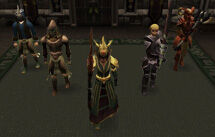
Players in diverse Dungeoneering garments, every bit seen on the main folio during the debut day and in the YouTube trailer.
To begin a dungeon, players must dismiss their familiar if they have one and deposit all of their items into a banking concern, such as the Fremennik Banker by the castle entrance.
Allowed items
- Ring of kinship
- Daemonheim aura 1, 2, 3, 4
- Any variant of the Dungeoneering skillcape
- Orb of oculus
- Festive aureola
- Any pendant of skill or prismatic pendant
- Mad necklace
- Pumpkin amulet
- Christmas pudding amulet
- Any Valentine necklaces
- Enlightenment aureola
- Illumination aura
- Hellion aureola
- Gorajo cards
- Advanced pulse core
- Support monkey trinket
- Dungeoneering party simulators
- Tainted shard
- Premier Artefact
Notation: The Gorajan trailblazer outfits or outfit pieces do not need to be worn or in the inventory for a actor to gain bonus feel. Bonus experience can be gained by keeping these items in the depository financial institution.
Starting a dungeon
The Ring of Kinship is required to offset or join a dungeon party in Daemonheim. The band tin can be acquired or reclaimed by talking to the Dungeoneering tutor beyond from the Fremennik Banker.
Inside the castle courtyard, there are several energy barriers, and two entrances in the east and west walls which players may enter, bold they see the requirements to do and then. The barriers are:
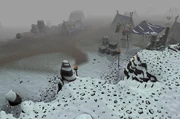
The entrance to Daemonheim
- Free-for-all barrier
- Frozen floors bulwark, if complexity 6 is unlocked
- Abased i floors (commonly abbreviated "a1", "aba1") barrier, if flooring 12 is unlocked
- Furnished floors (commonly abbreviated "furn") bulwark, if flooring xviii is unlocked
- Abandoned 2 floors (commonly abbreviated "a," "a2", "aba", or "aba2") barrier, if floor xxx is unlocked
- Occult floors (ordinarily abbreviated "o" or "occ") barrier, if floor 36 is unlocked
- Warped floors (commonly abbreviated "w" or "warp") barrier, if flooring 48 is unlocked
- The southwestern and southeastern dungeon entrances are for players who manually create parties, and are too the entrances used if players wish to train with any political party size lower than five.
In the primal 'Free-for-all' barrier, players are automatically teamed upwardly to course a party to any flooring. The other barriers exercise the aforementioned, except with floors restricted to their theme. If at that place are not plenty players to form a full party, the dungeon will begin regardless after some time, even if the thespian is alone.
It should exist noted that very few players use the bulwark-grouping rooms, instead choosing to manually create parties and thus brainstorm dungeons via the 2 dungeon entrances in the southwest and southeast. This allows players to choose advisedly who they Dungeoneer with and what floor(south) they would like to complete.
Making a party
To begin hosting a dungeon, the thespian must choose the option "Open Political party Interface" from the Ring of Kinship. This opens an interface where the dungeon'south floor, complexity, and party size tin can be set, among other options. Political party size can be anywhere from ane to 5 people.
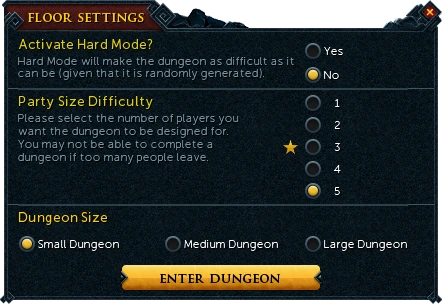
The dungeon's size and party size difficulty are set upon beginning a dungeon at either entrance.
Note: To solo a dungeon, you must grade a party (you will be the just party fellow member). Y'all can then begin a floor past entering the southeastern barrier behind the banker.
Floors
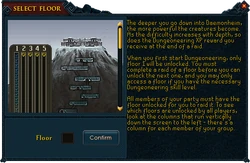
The screen for selecting level
There are 60 floors to Daemonheim. The higher the floor, the greater the xp upon completion, and the higher the level of the enemies and overall difficulty. To access a given floor, all players in the political party must have a Dungeoneering level of at least twice the floor number, and so minus 1. For case, level 39 is required to unlock floor twenty ((20 10 2) - i = 39). Moreover, to unlock a floor, the previous floor must be cleared once the actor has the level for the adjacent. For example, a role player with level 38 Dungeoneering completes floor 19 and later reaches level 39, they must complete flooring xix over again to unlock flooring xx.
The accessible floors of every actor in a party are shown in separate columns in the Party interface. A floor is only suitable for a dungeon if information technology is accessible to the entire party.
Floors in the columns are assigned tick marks if they accept been completed since the player'southward last ring reset.
Complexity
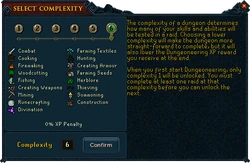
The screen for selecting complication
Complication is a 6-tier calibration that determines how many skills will exist involved with the dungeon—the higher the complication, the more skills accessible. There is a punishment on Dungeoneering experience that diminishes every bit the complication is set higher, until it vanishes entirely at complexity 6.
All skills are incorporated with complexities v and 6, and all free-to-play skills are bachelor with 3 and below.
It is recommended to do small floors on complexity 1 and medium and large floors on complication 6.
Dungeon size
Dungeons are generated in small (4x4 grid), medium (4x8 filigree), or large (8x8 grid) sizes. A dungeon may contain up to the maximum number of rooms possible from that grid, but mostly the room count is smaller due to bare areas on the map.
The maximum number of rooms per size is:
- Minor: up to sixteen rooms
- Medium: up to 32 rooms
- Large: up to 64 rooms
Dungeon size, coupled with party size and floor depth, are the major factors in experience rewarded upon completion. Large dungeons can only exist started with parties of 2 or more than.
Suggested dungeon size
In general, it is recommended to complete floors on large difficulty, as more experience is awarded per floor. All the same, this is non always the case—some players prefer to complete mediums, finishing more dungeons in the same amount of time at the cost of experience and efficiency per band-reset.
The thespian should not be afraid to experiment with dungeon settings, as there are many factors that affect overall efficiency. If he or she dies often on big floors, reducing xp, or has difficulty exploring efficiently, mediums may be the better selection.
As large floors are not notwithstanding available for parties with only one player, medium floors are recommended for solo players.
Prestige
Prestige is a crucial chemical element to gaining maximum experience per dungeon. One time all possible floors accept been completed (all floors with tick marks) since the player's terminal reset, the Prestige should be reset to ensure maximum experience gain.
Party size difficulty
Every dungeon is designed for a specific number of players, ranging from 1 to v. This number affects drops, the combat levels of the monsters, the players required for puzzles, and fifty-fifty characteristics of the dominate. The number of players the dungeon is built for tin exist set manually when beginning a flooring. Information technology is not possible to set the number higher than the amount of party members.
More than feel is awarded with a larger political party size, although soloing and 2 person are feasible options, even if not every bit efficient.
It is worth noting that if players leave the dungeon, puzzles requiring the full amount of players can no longer be completed. This can exist avoided by setting the dungeon to generate for one less player (for example, setting it to 4 in a 5-man party), only this reduces the Dungeoneering feel earned. The conclusion is upwards to the political party host.
Guide mode
Guide manner is an pick accessible in the party interface. Enabling it highlights rooms on the dungeon map that are essential for dungeon completion (that is, rooms that are not bonus). However, completing a dungeon with guide mode reduces feel awarded on completion past 5%. Guide manner is always active in complexities 1 to 4.
Gameplay
The ultimate goal in raiding a dungeon is to locate the boss and defeat it, granting admission to the exit ladder. However, in society to locate the boss, parties must slay monsters, solve puzzles, craft items, and both observe and utilise keys, all while traversing the dungeon's deadly labyrinth of rooms.
Practice and strong teamwork are essential for efficient Dungeoneering.
The Starting Room
When the raid begins, all players will be transported to the dungeon'due south starting room. The key features are:
- The Smuggler. Items and commodities can be purchased from him using coins earned within the dungeon.
- "Alter my starting items" - You can talk to the Smuggler to switch between receiving coins or receiving a prepare of feathers, rune essence, and antipoison. It is recommended to switch from coins to these items to speed the start of your floor.
- The starting equipment tables. Relatively depression-level equipment, nutrient, rune essence, and modest stacks of coins tin be claimed here.
- The Group gatestone portal (only available in college complexities). Attainable through one of the walls, this portal allows players to teleport to the Grouping gatestone.
- The construction hotspot. Past default this is the aforementioned Grouping gatestone portal, just with the correct materials and required Structure level, the portal may be replaced with a multifariousness of other facilities. See Dungeoneering/Construction.
- A runecrafting chantry. Different runecrafting altars on the surface, altars in Daemonheim are able to craft whatsoever not-combination rune except Armadyl, provided the histrion has the required Runecrafting level. Farther altars may be found elsewhere in the dungeon.
- A Summoning obelisk (simply available in complexities 5 and vi). Functions like a standard summoning obelisk, although restricted to Dungeoneering-specific pouches and scrolls. Further obelisks may be found elsewhere in the dungeon.
- The Divination crater. Unlike the obelisk or altar, this crater is the only one in the dungeon. Harvested memories tin can exist refined here.
The Dungeon Home Teleport spell (commonly abbreviated as "ht") returns the player to the starting room for free.
Gatestones
A gatestone is an item that, when dropped, allows the player to teleport to it from anywhere in the dungeon, except nether very rare circumstances. This teleportation is extremely important to immigration floors with speed.
There are three types of gatestones:
- The Group gatestone (commonly abbreviated "ggs" and only available on complexities v and half dozen). The party leader is given this gatestone by default at the start of a dungeon. It may be traded and dropped as the party wishes. This gatestone can exist teleported to via the Group gatestone portal or, more conveniently, the Group Gatestone Teleport spell, requiring 64 Magic and 3 Police runes.
- The personal Gatestone (commonly abbreviated "pg"). This gatestone is non given at the beginning of a dungeon and must exist created with the Create Gatestone spell, requiring 32 Magic and 3 catholic runes. When dropped, the gatestone is visible only to the histrion who placed it. It cannot be traded. The thespian may teleport to their gatestone with the Gatestone Teleport spell.
- The Gatestone ii (normally abbreviated "pg"). This gatestone is a second personal gatestone, unlocked after completion of the Elite Daemonheim Tasks. Different the Create Gatestone spell, the Create Gatestone two spell requires no runes. Both gatestones tin can be created and dropped separately. The player may teleport to their second gatestone with the Gatestone Teleport 2 spell.
Information technology is recommended to place gatestones well-nigh doors that crave keys which have yet to be obtained, or in branching parts of the dungeon far from the starting room.
Doors
Players progress through the dungeon by inbound rooms through doors. However, there are different types of doors with different criteria to permit access.
- The basic door. This door has no requirements for entry and a histrion may laissez passer through equally soon as they find the door.
- A Guardian door. This door is locked until all hostile monsters within the room accept been killed. Such doors will relock if a Reborn warrior teleports into the room. These doors are responsible for the bulk of combat inside Dungoneering.
- A Key door. These doors are locked unless the political party possesses the required cardinal. Keys can be found on the footing throughout the dungeon. These keys follow the template of having a random colour and random shape, both called from a list of predefined configurations. Note that within a dungeon, there is only one door for every key and vice versa. See Dungeoneering keys for more information.
- A Skill door. These doors endure various blockages that tin can exist cleared with a sufficient level in a required skill. See Dungeoneering/Doors for a full listing of these doors.
- A Puzzle door. These doors require completion of a puzzle before they will unlock. In some cases a puzzle is required simply to access a door, which may exist a door of whatever other type except a Key door. See Dungeoneering/Puzzles for a full list and techniques for each puzzle.
When a door has not yet been opened by anyone in the party, the first attempt to open information technology volition reveal the room on the other side, and the thespian will non enter. It is the second attempt in which the player enters.
Other features of gameplay
Political party mechanics
- The squad is linked by the Ring of kinship. The ring performs several functions within the dungeon, mostly within the extra interface tab that it generates. The band interface allows the toggling of shared feel, monitoring of team status, and allows teammates to view other teammates' inventories, familiar inventories, stats, and equipped items.
- The player may use the Customize option on their Ring of Kinship, obtaining a passive effect defended to either Melee, Ranged, Magic, or Skilling. There are twelve effects that may all exist upgraded with Dungeoneering tokens, although only one outcome may be active at in one case, or two, if the player has completed the Daemonheim Tasks. It is highly recommended to invest tokens in this feature. Run across Ring of kinship for more data.
- Messages typed in public conversation are broadcasted to all players regardless of the players' altitude from each other.
- The leader of a Dungeoneering party may indicate a monster with a flashing arrow by right-clicking the monster and clicking Mark. This can be used to highlight unsafe monsters or guide the political party. The pointer may exist removed by selecting Mark once more.
- The dungeon will instantly expire if all players have left the party, either past quitting or by logging out. It is possible to return to a dungeon after logging out if at least one party member has remained online.
Items
- When Dungeoneering, the thespian has a separate tool belt. The items required tin exist purchased easily from the Smuggler, with the exception of higher-level pickaxes and hatchets, which may exist smithed or obtained equally a drop from the Bulwark beast. It is safe and even recommended to bind a college-level tool than y'all can utilise, equally the tool will instead function as the highest-level tool bachelor to you lot.
- All armour, weapons, runes, ammunition, food, and other supplies necessary will be provided or can exist made (provided the player's party has the skill levels and materials required) or otherwise received every bit drops from monsters and bosses. Tier 11 equipment, which requires level 99 in its corresponding skill to utilise, tin only exist obtained as a dominate drib.
- Every boss will only drop ane or two types of equipment. These bosses can be targeted by players seeking high-level items to bind. Come across Dungeoneering#Bosses for which bosses drop which items.
- Upon quitting a dungeon (not completing), all the role player's not-leap items are dropped where they left. If the histrion has merely logged out, they may pick upwards their items again afterward returning to the dungeon unless the items have been claimed by teammates. Gatestones, however, are destroyed.
- Dropped items do not vanish with fourth dimension as they commonly do in the RuneScape overworld, and announced immediately to all players as they are dropped. This includes monster drops (with the exception of Slayer drops), items dropped from the inventory, and items abased upon quitting a dungeon. The just items that volition vanish are ashes, bones dropped by a thespian, and burnt food.
Other
Oh dear, yous are dead!
- Upon death, players respawn in the starting room, and their death counter is increased past 1. All items are retained except for carried gatestones, which are dropped at the site of death.
Roles of the team
Through quality-of-life updates, Dungeoneering has over time gotten easier, and there is at present less need for designated political party roles. Nevertheless there exist certain tendencies.
- Host/Political party leader - The host of the party is unremarkably the phonation of authorization. This extends to deciding where the Group Gatestone should be and calling for the party to assemble at guardian doors or skill doors. In casual teams, peculiarly with players who do not know each other, this authority is relaxed or nonexistent. The keyer too has the ability to marking monsters with a aureate arrow, only in practice this is seldom used.
- Fighter - A player who focuses on clearing guardian doors.
- Skiller - Although rare, there are some players who do not fight within the dungeon and instead procedure commodities for themselves or the team, for example by making a prayer altar. These players usually purchase floors rather than Dungeoneering with random players, because overall the dungeon is slowed downwardly.
It is very important to notation that in skilled teams, these roles are largely redundant. All players piece of work together to dissever upwardly, open doors, manage their gates, and solve puzzles.
Ideally, players will open up doors and follow paths carve up to each other while communicating to the rest of the party.
Abbreviations used within Daemonheim
In that location are many abbreviations used within Daemonheim, for different items, bosses and puzzles.
Shared experience is an option set on a per-player basis. The party leader cannot change this for other players. Players may cull to receive experience from the activities of other players or non by clicking on the XP button to the right of their name in the party interface. This option tin be changed on the wing, unlike other options, which are set earlier the dungeon and and so cannot be inverse while in the dungeon.
The feel gained by using skills or opening skill doors is shared amid the person doing the skill and everyone in the party with the required level who has the option enabled. Players do non receive shared experience from deportment that they could not take done themselves because of level. Players as well never receive shared combat experience from fighting creatures or prayer experience from burying bones, even if the choice is enabled. However, all feel from opening skill doors or completing skill puzzles can be shared, even for gainsay and prayer.
If a thespian turns off shared experience, it does not prevent feel from the player's activities from being shared with others. The option simply controls whether players receive shared experience from other players, non whether they share their own feel.
Using shared experience does decrease experience gained of you lot and others. This is also adamant by whether or not party members have the required level to do the actions in question. The experience distribution is 55% to the political party member doing the activity and 45% to those with shared exp on, for a political party of size two.
Finding a team
When finding a squad, many players use abbreviations. For instance, the abbreviation for the floor of the dungeon is "F". It is common for players to say "merchandise me" or "Hosting" if they wish to be the party leader and need members for their party. It is besides common for players to say "inv me", "need floor (x)", or "northward(x)" where (10) is the flooring, if they wish to be invited to a party. Another fashion of hosting floors people tend to use is, for east.g. when doing an Occult floor - "O+4" is used to show the role player is hosting an Occult and needs another iv people to have a full party of v.
Players can gain prestige for completing floors that have already been marked off in a particular theme, provided that another floor in the theme remains unmarked. For example, a player who needs to marker off flooring 36 can join a party hosted on floor 37 in gild to mark off the lower floor at its relevant base experience. This has made it easier for players to bring together teams, particularly at higher Dungeoneering levels. However, caution should be taken, as joining a party hosted on a lower floor level will event in the actor receiving the base of operations experience of the lower floor.
It is besides much easier to find players that can admission lower floors, as these are accessible to a greater number of players. Accordingly, when participating in big dungeons, players should aim to complete deeper level floors get-go. This volition ensure that the relevant base feel is obtained, and that minimal difficulty occurs in finding a team relevant for your Dungeoneering endeavors.
The forums are another good manner to find a squad. It is nether the "RuneScape-Specialist" forum. And so click on the "Adventuring Parties" category. Here you tin can make a new thread stating what floor, what complexity, and specific requirements (ex. Combat 100+ just) you would like in your grouping. Another option is to look through the forums and find somebody that you tin can help. One other like shooting fish in a barrel way to find other people wanting to join a party or looking for people in a political party is to bring together a Dungeoneering association. Dungeoneering servers are oft so crowded that the chatbox moves also fast to read when at Daemonheim.
Binding items
When outset to train Dungeoneering, players on a high complexity will begin every dungeon with only their Ring of Kinship, except for the party leader, who is given the Group gatestone. However, certain items can exist bound — that is, they will announced either equipped, in the player's inventory, or in the bind pool at the start of every dungeon. To demark an item, correct-click an item then click "Bind".
The items that may exist spring are:
- A weapon, stackable throwing knives included
- A piece of armour or jewellery
- An armament bind: either a stack of arrows or a stack of runes (up to 125, or 225 with completion of Salt in the Wound). A stack does non need to exist bound at once; for example, if a thespian has 125 arrows leap and then completes Salt in the Wound, they may obtain 100 more arrows of the same type and add them to the bound stack.
- A potion (with completion of the Medium Daemonheim Tasks)
It is worth noting that potions and stackable items are given their own bind slots separate from the balance — they do not take up slots in the bind pool. Additionally, an armament demark cannot be viewed in the bind puddle, and must be managed in the role player's inventory or worn equipment interface.
All bound items are identifiable as having a (b) appended to their proper noun. All of a actor's bound items are viewable in their bind pool, which is accessible from the Smuggler. Although the demark pool holds 10 items or, if the player has completed the Hard Daemonheim Tasks, 12, the player can only carry a small number of those items at once: their active bound particular limit. That number increases with a college Dungeoneering level.
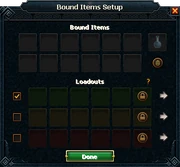
The Spring items interface
| Dungeoneering level | Number of Active bound items |
|---|---|
| i | 1 (2 if using an off-hand detail) |
| 20 | two (3 if using an off-manus particular) |
| 50 | iii (four if using an off-hand particular) |
| xc | 4 (five if using an off-hand item) |
| 120 | 5 (vi if using an off-hand item) |
The demark pool besides offers three loadouts for the player to create and habiliment while Dungeoneering. Each loadout is limited by the amount of binds a player may carry at once. A loadout is set past dragging leap items from the puddle and onto the loadout'due south spaces. The aforementioned particular may exist used on more than than 1 loadout. Potions and armament binds cannot be included in a loadout every bit they are carried automatically, and thus, neither armament nor potion binds count towards a player's active spring item count.
One loadout may be marked with the check mark to the left of the interface to select that loadout every bit the default upon starting a dungeon. Items in that loadout will exist equipped on the player, and if ii bound items compete for the same slot, the unworn item will exist placed in their inventory. Other loadouts may exist temporarily adopted during a dungeon by clicking the respective white arrow to the loadout'due south right.
Bound items cannot be traded, sold, or alchemised, and to unbind an item is to destroy it permanently. The only style to reclaim an detail is to obtain some other of it, either by making i or receiving i as a monster or boss driblet.
Suggested binds
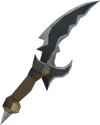
The highest-levelled weapon the histrion can wield and reasonably obtain should e'er be their offset demark. As more active bind slots are unlocked, the player is given more immediate options. High-level armour is a recommended next demark.
When bounden armour of the same combat course, the role player receives the most benefits per detail by prioritising body armour above leg armour, and so higher up head armour, and then above gloves and boots.
An important item to consider binding is the Shadow silk hood. This piece of hybrid armour is usually used among players of all combat classes. Wearing the hood makes the thespian invisible to all humanoid enemies except mages. Annotation even so that some mage monsters such as Forgotten mages, Necromancers, Reborn mages, Mercenary leaders, and Seekers may disable the hood's result for an corporeality of seconds that increases with the monster's combat level. This item is very useful as a sole piece of armour, simply it is not necessarily the best choice, and can exist replaced with higher-level headgear when the thespian has access to multiple pieces of armour at once. This detail is obtained as a rare drop from the Night spider, which requires 41 Slayer to kill.
There are some other items that, while more often than not not of use, are worth knowing about:
- The Claret necklace. When worn, this particular volition every 15 seconds deal 400-600 damage to all side by side enemies and heal the thespian for the damage dealt. Information technology likewise provides a small impairment bonus to all gainsay styles. It is obtained as a rare drop from the Edimmu, which requires 90 Slayer to kill.
- The Hexhunter bow. While statistically junior to the Sagittarian longbow, the Hexhunter bow (also a shieldbow) has a passive result that raises damage against magical targets. It is obtained equally a rare drop from the elusive Soulgazer, which requires 99 Slayer to kill.
For an ammunition bind, players who accept completed the Medium Daemonheim Tasks tin can merits 40 free law and cosmic runes from the Smuggler to create gatestones with. This and the use of Runecrafting frees up the ammunition demark for arrows if the player chooses to use a bow, although if the player uses Melee, which requires no ammunition, or Magic, which uses weapons that provide their ain runes, they may choose to bind extra law or cosmic runes regardless. Alternatively, nature runes, coupled with a magic weapon to provide fire runes, allow a source of income through High and Low Level Alchemy, and Astral runes may be used to cast Lunar spells, such as Cure Me.
For a potion bind, it is recommended to demark a strong combat potion to consume early in the dungeon and thus quicken clearing of guardian doors with. Alternatives include a Strong gatherer's potion to enhance Divination to create higher-level Portents of passage.
Ending a dungeon
Players may leave the dungeon at any time via the ladder in the starting room or via the "Go out Party" push button in the party interface.
In order to complete a raid, the boss must be defeated (meet Bosses for tips on defeating the boss). At this point i player will receive a random particular from the dominate's drib table, and a ladder to the next level volition appear on the wall. Players may and so opt to complete the dungeon and begin the next raid by clicking the ladder.
As before long as one person clicks on the ladder and selects the "Yes, continue" option, a timer will start to count down to the end of the floor, the length of which (in minutes) is 1 less than the number of players. The time will reduce by a infinitesimal each time some other actor opts to leave. Therefore, if all members of the party opt to leave, the dungeon will end instantly.
Players will then receive Dungeoneering feel, and be shown a dialogue box indicating how much experience was gained, and the bonuses and penalties that determined this. This will directly touch on your token proceeds as well, every bit you proceeds 10% of your feel in tokens (that'due south i token per ten feel, or for an easy way to figure it out, driblet the terminal digit of the experience needed, or if finding how much experience i would need for a reward, add a zero to the end of the tokens required). Come across Dungeoneering/Winterface for more details.
Later 30 seconds, the party volition motility on to the next floor automatically, equally long every bit everyone in the party has a high enough Dungeoneering level. Otherwise, the same flooring volition be repeated. If the skip calculation button which is initially in the height correct of the interface is clicked, information technology will be replaced by several numbers in boxes, each representing a histrion in the party. These tin can be used to skip the interface, if everyone in the party selects "Gear up", or exit the party and render to the surface, by right clicking and selecting "Go out".
XP calculation is ever calculated using the following formula (notation that prestige XP, penalty percentage, and bonus XP pct may exist 0):

Annotation that penalties and bonuses bear on your overall experience by lowering and raising the base experience past certain percentages, rather than the Active Flooring experience.
Daemonheim Task Set
The Daemonheim Tasks are the tasks relating to Daemonheim and its surrounding surface area. They were released on ten September 2013.
To start the tasks, players can speak to Drangund, Marmaros, Talsar or Thok, who are all located in the camp well-nigh Daemonheim. Players are rewarded with an aureola.
Hard mode
Hard fashion is unlocked after completing the Elite Daemonheim Tasks. Information technology is a Dungeoneering characteristic that was released x September 2013. It is available for complexity 6 dungeons only and makes the dungeon as hard as it can randomly be.
Thok volition prove players the list of floors completed in hard mode.
Fremennik Sagas
The Fremennik Sagas are a combination of Questing and Dungeoneering, where sagas told by Skaldrun play the chief office.
Skills
Every skill can be used in some style while raiding the dungeons. They tin can give advantages, such as admission to bonus rooms, or are sometimes necessary to complete a dungeon. The uses of skills while in a Dungeon are unique to Daemonheim. Doors that crave skills to open showtime at Complication 5.
Inside dungeons, when a player performs a skill task, they will receive a set amount of experience for it (for doors, it depends on the level that was required for the door). At the aforementioned time, anyone with experience sharing enabled via their Ring of Kinship'south party interface will receive a reduced amount of experience from the aforementioned task, and so long as the player has the level required to perform that action too. If the actor does not take a high enough skill level to perform a task, they will receive no experience at all for the chore (ie, someone else called-for a grave creeper branches when the player only has a Firemaking level of 89, the player will non get experience at all considering grave creeper branches require a Firemaking level of 90 to burn down). This is a prissy benefit to dungeoneering in groups.
| Skill | Uses | |
|---|---|---|
 | Attack | To increment the chance of doing damage to the monsters and bosses, if using melee. Also lets yous wield better weapons. |
 | Agility | To pass certain obstacles in the dungeons without receiving damage and there are some doors which require a certain Agility level to open up. |
 | Constitution | To exist able to withstand more than hits from the powerful monsters and bosses, and therefore survive longer in the dungeons, significant you die less. |
 | Structure | To repair cleaved doors that can't exist opened, and to repair broken barrels so that they can exist pushed to unlock rooms. Used to set up the supports in the mining room. With the nineteen July "Dungeoneering 1.five" update, Construction may at present exist used to build diverse skill hotspots in the start room by using the items needed to make a certain object and right clicking on the Group Gatestone Portal or whatsoever is currently built and clicking on "Supersede". |
 | Cooking | Used to cook raw fish on a fire or range to prepare food that can be used to heal. Also used to add fish and then mushrooms to potatoes. Additionally, cooking is used to get through the Fremennik Campsite puzzle room. |
 | Crafting | To brand ranged and magic armour from raw materials. Also used to fix pulleys in broken doors and so that you can open them, and to arts and crafts stone body parts for magical constructs and weapons for statues so you can laissez passer the room. |
 | Defence | Lowers the run a risk of getting hit by the monsters and bosses, and lets you wield better armour. |
 | Divination | Used to create various types of Portents of passage and Portents of restoration. Besides used to drain certain doors of divine energy to open up them. |
 | Farming | Allows players to grow food and potion ingredients in farm patches, also as to pick plants for mage armour. Also used to prune vines from certain doors in order to open them. Jagex confirmed that there will be more options in Dungeoneering to use Farming before long. |
 | Firemaking | To set fire to branches, allowing you lot to cook food on them. Also used to fire log piles blocking doors in order to open them. |
 | Fletching | Used to make bows, arrows, arrow shafts, staves and hunter traps. |
 | Line-fishing | To collect raw food from angling spots located around the dungeon. Also used for certain puzzles. |
 | Herblore | Used to create potions from ingredients bought/found in the dungeons. Likewise used to open up doors. Jagex has confirmed that there will be more options in Dungeoneering to utilize Herblore in the future. |
 | Hunter | To allow players to ready traps fabricated with the Fletching skill. As well used to catch ferrets with crystals around their necks, which will open up doors. |
 | Magic | To let players to dispel the magical barriers on sure doors. Too used for its normal use in combat, equally well equally charging the magical constructs that appear on floors four and up. Magic is too used to activate lodestones that appear in the 4 colour room to align all the crystals into ane to activate the low-cal in the heart to arrive brightly lit. |
 | Mining | Used to harvest ore from rocks, used in some events to mine stone from rubble and to unblock doors covered with rocks. |
 | Prayer | For exorcising night spirits from sure doors so that yous may pass through them, every bit well as its normal utilise in combat. Recharging prayer is express to a certain corporeality of points per dungeon depending of the size of the dungeon you lot are in. In pocket-sized dungeons, the amount you can recharge is 10 times your prayer level, in medium dungeons it'south 20 times your prayer level, and in large dungeons information technology's 30 times your prayer level (with a Prayer level of 89 - 890 in pocket-size, 1780 in medium, 2670 in large). Caution is advised regarding prayer usage. Additionally, bones may at present exist used on Daemonheim'due south altars to gain 4x feel. |
 | Ranged | Allows you to wield amend bows and armour, and increases the damage when using ranged in combat. Ranged is also used in some puzzles, such as guiding the ferret onto the pressure pad puzzle. |
 | Runecrafting | To craft runes to be used in spells. To enhance crafted staves with elemental or catalytic powers. As well used in puzzles to activate crystals, flip tiles, and to imbue rune energy into doors so that you can open up them and into constructs that open up heavy doors. |
 | Slayer | For slaying some special creatures that crave a slayer level, that may requite special items as drops. |
 | Smithing | To plough ore into melee armour, melee weapons and arrow tips, or create tools for harvesting raw material. Likewise used to repair keys for some doors. |
 | Force | Increases the damage you practice when using melee to fight the monsters and bosses. Also allows you to open up barred doors, and push heavy barrels. Allows you to wield mauls of equal or lesser strength requirement. |
 | Summoning | To infuse and summon familiar pouches, assuasive them to fight for you throughout the dungeon. As well used to dismiss rogue creatures blocking some doors. Allows yous to understand what familiars say, which is useful for the summoning riddle puzzle. |
 | Thieving | Used to open some chests which contain items and picking the padlocked doors to unlock them. |
 | Woodcutting | To cut forest from various copse and growths around the dungeon. Also used to chop abroad barricades blocking doors then yous can open them. Used to chop dry sticks in the hunter ferret puzzle. |
Combat
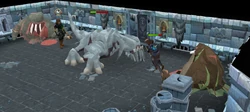
Players fighting a Epicurean behemoth
Combat while Dungeoneering consists of the iii set on types: Magic, Ranged, and Melee. Daemonheim has its own spellbook with a combination of Standard spellbook and Lunar spellbook, with three new spells besides. Ranged and Melee only use weapons specific to Dungeoneering, all of which tin exist player-fabricated, provided the resource can be found or bought and players take a loftier enough skill to Smith, Fletch and/or Craft them, besides Cardinal, Angelic, and Saggitarian equipment, which can simply be obtained from dominate drops.
The society in which monsters are preferably killed is commonly Shades>Mages>Rangers>Warriors. With this in mind the keyer should "marking" targets due to their damage ratio and position in the room.
This is based on the Shadow silk hood's ability to hide the wearer from all humanoids except mages and necromancers. Thus it would make sense that a team with hooded players would apply the hood'south concealment consequence to their advantage. Even if you lot don't have a hood yet, someday you may get one from a Nighttime Spider, and learning to take out monsters in this guild will non only help y'all in the future, simply volition help your team in the present. It also benefits those wearing metal armour, since mages pose the greatest threat to them.
Monsters
Bosses
Players must defeat the boss in order to complete the floor.
Once you lot enter a dominate room it will be nearly incommunicable to exit through the door during the fight. Information technology'south highly recommended that you lot create a gatestone before entering the dominate room to minimise the number of deaths. You should e'er determine what the dominate is instead of rushing into it. There are a couple of bosses, such as the Luminescent Icefiend, which you cannot fifty-fifty teleport out of, and then make sure you're ready for a fight.
| Floor Type | Boss Name |  | Floors | Drops |
|---|---|---|---|---|
| Frozen (Floors 1–11) | ||||
| Gluttonous behemoth | 1 | 1–11 | Boots | |
| Astea Frostweb | ane | i–11 | Wands and shoes | |
| Icy Bones | ane | 1–11 | Knives and vambraces | |
| Luminescent icefiend | five | 3–11 | Daggers and off-hands | |
| Plane-freezer Lakhrahnaz | 11 | 6–xi | Gauntlets | |
| To'Kash the Bloodchiller | 17 | 9–11 | Mage gloves | |
| Abandoned 1 Also institute in Abandoned 2 (Floors 12–17) | ||||
| Skeletal Horde/Divine skinweaver | 23 | 12–17; 30–35 | Helmets | |
| Hobgoblin Geomancer | 23 | 12–17; 30–35 | Leather boots | |
| Bulwark brute | 23 | 12–17; 30–35 | Pickaxes and Hatchets | |
| Unholy cursebearer | 29 | xv–17; 30–35 | Staves | |
| Furnished (Floors 18–29) | ||||
| Rammernaut | 35 | 18–29 | Mauls | |
| Stomp | 35 | 18–29 | Coifs and ranged shields | |
| Har'Lakk the Riftsplitter | 35 | 18–29 | Rapiers and off-hands | |
| Lexicus Runewright | 39 | 20–29 | Hoods and orbs | |
| Sagittare | 45 | 23–29 | Longbows and arrows | |
| Night-gazer Khighorahk | 51 | 26–29 | Plateskirts | |
| Abandoned 2 (Floors 30–35) | ||||
| Shadow-forger Ihlakhizan | 59 | 30–35 | Kiteshields | |
| Bal'lak the Pummeller | 65 | 33–35 | Warhammers and off-hand warhammers | |
| Occult (Floors 36–47) | ||||
| Skeletal trio | 71 | 36–47 | Shortbows and arrows | |
| Runebound behemoth | 71 | 36–47 | Robe bottoms and mage shields | |
| Gravecreeper | 71 | 36–47 | Chainbodies | |
| Necrolord | 77 | 39–47 | Chaps and off-hand knives | |
| Mankind-spoiler Haasghenahk | 83 | 42–47 | Platelegs | |
| Yk'Lagor the Thunderous | 89 | 45–47 | Battleaxes and off-manus battleaxes | |
| Warped (Floors 48–60) | ||||
| Blink | 95 | 48–lx | Longswords and off-hands | |
| Warped Gulega | 95 | 48–60 | Robe tops | |
| Dreadnaut | 95 | 48–lx | Platebodies | |
| Hope devourer | 101 | 51–60 | Leather bodies | |
| Earth-gorger Shukarhazh | 107 | 54–60 | Spears | |
| Kal'Ger the Warmonger | 113 | 57–60 | 2h swords |
Food
A consummate experience table for Cooking, complete with life points for the potatoes can be institute here.
Almost food available in the dungeon are fish, cave potatoes, and mushrooms. Cavern potatoes and mushroom seeds are institute mostly by killing monsters. Free players can only admission raw and cooked fish, and bananas using the basic to bananas spell though non any product of other food. Equally mentioned free players can merely proceeds food by buying or fishing them equally raw form, or loot from fallen enemies and smuggler room as cooked form.
As you progress through the dungeon, you lot will be able to grow and cook cavern potatoes, which you can then combine with fish and/or mushrooms to form more circuitous foods.
For case, Raw cavern potatoes and mushrooms are grown in a subcontract patch and accept about i minute to grow. To cook them you demand a range, some logs, and a tinderbox OR just logs and a tinderbox. Note that unlike on the surface, cave potatoes can exist cooked over ordinary fires, although at that place is a significantly increased run a risk of burning them. Use the logs with the range and and then the potatoes with the range. And so add the fish, and/or your choice of mushrooms. There are 2 kinds of mushroom, Gissel mushroom and Edicap mushroom, which heal 30 and ninety LP, respectively. Gissel mushrooms require a Farming level of 34, and Edicap mushrooms require level 68 Farming. Baked cave potatoes heal xxx LP plus the total amount of LP healed by the ingredient(s) they are combined with. For example, a Gissel mushroom and Save eel potato will heal 260 LP, whereas the Save eel itself heals 200 LP.
You may also employ food items with other players to heal them. Without whatsoever medic property of Ring of Kinship, food tin can heal 100% corporeality of life points. They volition go a bulletin maxim "[Actor's Name] gives you lot a [food item], which you eat." This will end both player's action of attacking, and temporarily stop both from moving. If they already have full life points and you try to use food with them, you lot will get a bulletin saying "As tasty as a [Type of Food] is, [Player's Name] already has full life points".
Spellbook
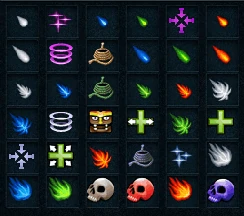
The spellbook contains a combination of the Lunar and Standard spellbook spells. At that place are four new spells which help players teleport around while Dungeoneering: Dungeon Home Teleport, Create Gatestone, Gatestone Teleport, and the Grouping Gatestone Teleport.
Puzzles
In addition to regular monster-filled rooms, a dungeon may contain 1 or more than puzzle rooms. These puzzles range in difficulty and complexity. Many puzzles require certain skill levels to be performed and accomplished, and others may cause the players to suffer harm if the puzzle was non washed properly.
Rewards
Dungeon traversed!
Music announcing the completion of a floor.
Upon completion of a dungeon raid, players will receive Dungeoneering skill feel and a number of tokens equal to a 1:ten ratio of the feel received (i token per x feel). These tokens are smuggled outside of Daemonheim then that they may be traded with the rewards trader in the Daemonheim camp for items to exist used outside of the dungeons. Players may too receive weapons, armour, or other things that they can bind and accept to the side by side flooring.
Resources dungeons
There are 20 resource dungeons scattered all over Gielinor. Each requires a certain Dungeoneering level to enter and grants a quondam Dungeoneering feel reward upon first entry.
Every dungeon contains creatures, resources, or both. Some of these entities are exclusive only to their respective resource dungeon.
Journal
While Dungeoneering, one tin can sometimes find parts of dissimilar journals near the exit ladder after a boss is defeated. They can also be dropped by monsters, albeit rarely. They tin exist viewed at whatsoever time past talking to the Dungeoneering Tutor just outside the gates of Daemonheim. However, they are of no use within dungeons afterwards players choice them up from the monster they received it from, and so they may be destroyed safely.
Guides
Music
Tips for unlocking music
- All Glacialis tracks are unlocked on the Frozen floors, all Desolo tracks are unlocked on the Abandoned floors, all Adorno tracks are unlocked on the Furnished floors, all Occulo tracks are unlocked on the Occult floors, and all Torqueo tracks are unlocked on the Warped floors.
- All v themes will accept ten possible music tracks to unlock non including the vi Boss-specific tracks in each theme.
- Every time players enter a room with an enemy in it, the music player will randomly select a track. If the room is repeatedly entered and exited, players can unlock these music tracks very quickly.
- All bosses have their own music, so if players want to unlock them quickly, they should practice small dungeons with the 'guide' pick turned on. If the room before the boss has monsters in it, there is a glitch where it volition not unlock the music track. If they are looking for a specific boss and take completed plenty Daemonheim tasks, they can apply their Daemonheim Aura to choose which dominate to face at the end of the dungeon.
Temporary boosts
- The Dungeoneering cape and the Dungeoneering chief cape boost the skill by 1 level temporarily. Nevertheless, the boosts of these items vesture off as shortly every bit they are unequipped. It is possible to temporarily reduce the dungeoneering level via the frost outcome at the entrance to the God Wars Dungeon, resulting in the inability to access higher floors. For example, at 1/99 dungeoneering, it is only possible to access flooring 1, instead of floor fifty. Withal, if the flooring has been ready before the skill level is lowered, players can still access that flooring fifty-fifty if the interface does not show the floor. Admission to the dungeoneering resources dungeons are not affected by the stat reduction.
- Toffee apple tree and Carbohydrate skull obtained from the SoF during the 2012 Hallowe'en event have the possibility of boosting your Dungeoneering level by 2.
Achievements
Skilling pet
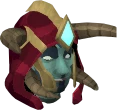
Like all skills, there is a skilling pet obtainable from grooming this skill. The pet for the Dungeoneering skill is called Gordie.
Rollback and organisation updates
On xiv Apr 2010, at approximately 5:00pm (UTC), Jagex had to shut down the RuneScape servers due to a Dungeoneering related bug where the feel for crafting all runes was accidentally increased (2000 feel points per nature rune, 1400 feel points per fire rune, etc) instead of being decreased. All accounts were rolled back past nearly thirty minutes. The login server was offline for four hours.
There were also numerous system updates throughout the first week after Dungeoneering was released as developers scrambled to set up various design bugs as they were uncovered, many of which made certain rooms incommunicable to complete, even with all the required skill levels. In that location were instances of multiple updates within one hr, which fabricated grooming extremely frustrating to players who were unable to stop a dungeon before the update occurred. They also cut the experience gained on free servers by l% for players with 90+ combat level. This update was mostly fabricated because many members logged into free worlds to railroad train dungeoneering considering the combat levels of monsters in free worlds are lower than those in member worlds.
Gallery
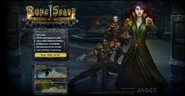
The RuneScape splash page following Dungeoneering's release
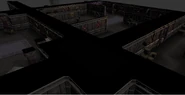
Diverse other rooms constitute near the railway area
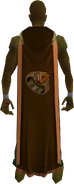
A role player with level 99 in dungeoneering

120 Dungeoneering emote
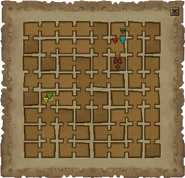
A completely filled grid
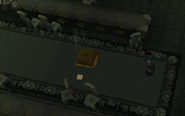
A Dungeoneering key receiving a lootbeam with an Unreadable page adjacent to it.
Trivia
- This is the get-go F2P skill to be released since Runecrafting piffling over half a decade ago.
- When a histrion completes the Tears of Guthix action, the message for increasing the Dungeoneering skill is "Y'all feel the mysteries of Daemonheim unravel."
- The use of any XP lamps, experience-boosting items or XP rewards on this skill was not possible for the first 14 days after the release of Dungeoneering.
- In 2004, Jagex released an "Upcoming updates" commodity in which plans were announced to add together to the game "Randomly generated scenarios, where a new adventure is generated for you and your friends each time you proceed it. Form an adventuring party and go on your own personal quest".[i] Not until 2010, withal, was Dungeoneering actually released.
- The expiry counter in the upper left corner will exist maxed at xv, pregnant that dying more than 15 times in a dungeon counts equally dying only xv times.
- In September 2010, at that place was a bug that allowed players to get twice the experience upon finishing a floor. Many of the players who were in summit five at that fourth dimension (level 114) quickly got level 120 within 24 hours. However, due to a fault in the bug detection organization, Jagex banned innocent players as well. As Jagex was unable to reliably tell which players driveling the problems, Jagex reversed the bans and gave all afflicted free membership.
- On 17 May 2011, Jagex added the get-go Player-made content to the Knowledge base of operations in the form of a Dungeoneering Skill Guide written past the role player Skiller . As such, this is the get-go Histrion written content which has been added to the Game Guide.
- The Occult floors can be seen near the railway expanse in Another Slice of H.A.M., when using the Orb of oculus. It is probable that these are the templates for generating a Dungeoneering floor.
- When two players in a party try to open the aforementioned fundamental door at the same time, there volition be two chat messages stating the cardinal is used.
- When a thespian enters the Occult and Warped floors, the Zamorakian-like symbol doesn't appear anymore on the carpet well-nigh the Smuggler at the starting room and the rest of the dungeon.
- Prior to seven August 2017, there were 3 themed Dungeoneering worlds: world 32 for levels 1-fourscore, world 117 for levels fourscore-100, and globe 77 for levels 100-120.
- While raw resource are stackable, their products are non; the maximum number of resource that can be processed depends on how many costless inventory spaces yous have earlier you get-go processing, even if inventory spaces are freed in the process by stackable burnt fish in the case of cooking. Information technology is as well impossible to process a single detail if there is no other inventory space.
Videos
- Jagex Dungeoneering Trailer
- Dungeoneering Developers' Blog
References
| Dungeoneering | |
|---|---|
| Daemonheim |
|
| Skills | |
| Miscellaneous | |
| Guides | |
 Thok of Daemonheim
 Bryll Thoksdottir
 Dungeoneering tutor
 Smuggler
 Bilrach
 Rewards trader
 Band of kinship (Classes)
 | Skills | |
|---|---|
| Combat |
|
| Gathering | Mining Fishing Woodcutting Farming Hunter Divination |
| Artisan | Herblore Crafting Fletching Smithing Cooking Firemaking Runecrafting Construction |
| Back up | Agility Thieving Slayer Dungeoneering |
| Elite |  Invention Invention |
| Former skills |  Hitpoints Hitpoints |
Source: https://runescape.fandom.com/wiki/Dungeoneering
Posted by: harrisonabitte54.blogspot.com
0 Response to "How To Make Money On Runescape Non Member 2017"
Post a Comment